R version 4.5.0 (2025-04-11 ucrt)
Platform: x86_64-w64-mingw32/x64
Running under: Windows 10 x64 (build 19045)

Matrix products: default
  LAPACK version 3.12.1

locale:
[1] LC_COLLATE=English_United States.utf8
[2] LC_CTYPE=English_United States.utf8
[3] LC_MONETARY=English_United States.utf8
[4] LC_NUMERIC=C
[5] LC_TIME=English_United States.utf8

time zone: America/Chicago
tzcode source: internal

attached base packages:
[1] stats     graphics  grDevices utils     datasets  methods   base

loaded via a namespace (and not attached):
 [1] htmlwidgets_1.6.4 compiler_4.5.0    fastmap_1.2.0     cli_3.6.5
 [5] tools_4.5.0       htmltools_0.5.8.1 otel_0.2.0        rstudioapi_0.17.1
 [9] yaml_2.3.10       rmarkdown_2.30    knitr_1.51        jsonlite_2.0.0
[13] xfun_0.52 digest_0.6.37 rlang_1.1.6 evaluate_1.0.5 9 Technical Report
Documentation of your psychometrics project occurs within a technical report (aka “tech report”). The technical report contains, at a minimum:
Important 9.1: Technical Report Elements
Take special note of elements:
- 2 (Executive Summary)
- 3 (Table of Contents)
- 8 (Appendices)
…as these elements are unique to tech reports and extend beyond the expected content within, for example, a traditional “APA paper”).
Your goal within the technical report is exacting descriptive communication of the development and investigation of psychometric properties of your focal measure. You should apply whatever writing level is best suited to convey your thoughts with the highest level of descriptive integrity. Any anticipated reading–level limitations of how you communicate technical report information should not restrain your documentation. It is okay to assume a post–baccalaureate reading level – aka individuals who have similar advanced training as yours. Additional measure–relevant documentation in the form of white papers, local validation studies, and marketing material should be treated differently and target a general consumer audience (7th–grade reading level), but it is ok for your technical report to be “technical”.
Regarding the structure of your report, you are free to use style guidelines (such as those offered by APA (American Psychological Association, 2020) or MLA (Modern Language Association of America, 2021)), but you should not in any way feel constrained by these. The content of your technical report should reflect the elements discussed in this chapter (see also Important 9.1), but the format should reflect some uniqueness of the authors. Have some fun with the format – use icons, images, and even (non–wacky) fonts with restrained abandon. You may even want to consult a friend who has experience with graphic design or other artistic ventures. The look and feel should reflect YOU (or the organization you represent), not some stodgy arbiter of margin dimensions or running head structure.

The remainder of Chapter 9 focuses on each element of your technical report separately. The entirety of your report is merely an aggregation of these individual elements, although you should give greatest weight (in terms of page space and descriptive detail) to information contained in Section 9.5 and Section 9.6.
9.1 Title page

The title page may also be referred to as a “cover page” – we are considering these terms synonymous for the purposes of a technical report. This represents, with traditional hard–copy reports, the first impression of your project. Branding is important here – if you are representing an organization, there may be a pre–existing preferred format or structure. If you are representing yourself, think about not just this current project, but also future projects that you may wish to conduct. Once you decide on a styling, it is best to stick with it across future projects.
The title page elements to include are:
- Styling
- Project Title
- Author(s)
- Organization(s)
9.2 Executive Summary
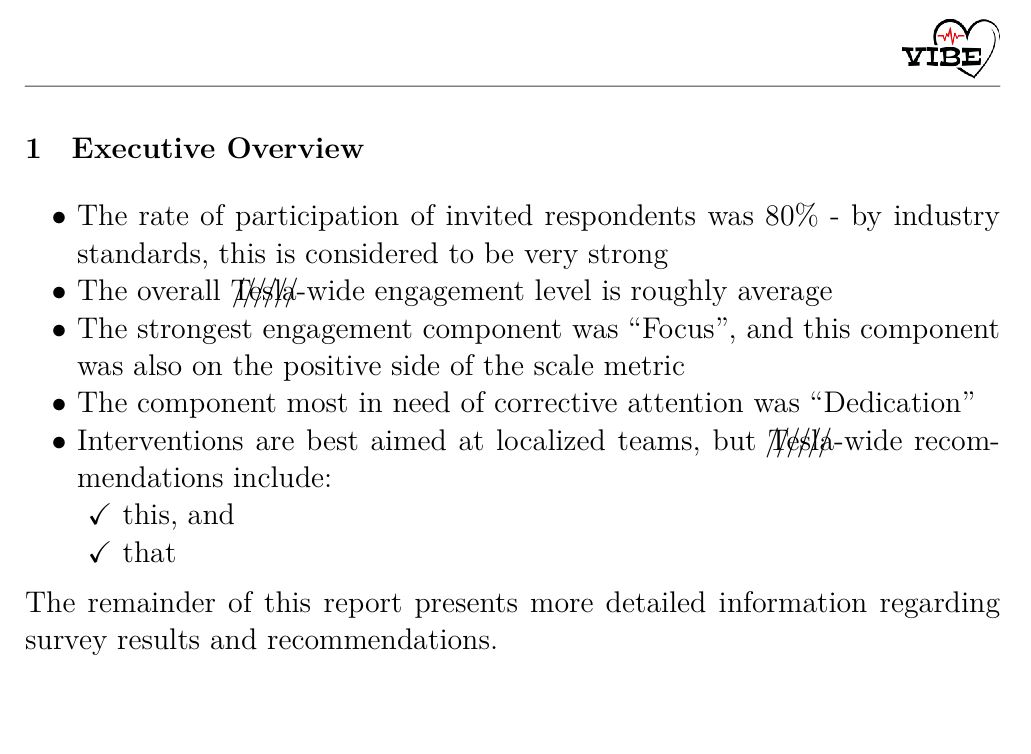
The executive summary is essentially an abbreviated Abstract. Although this content appears before the substance of your report, it should be treated like an Abstract and written last (only written after all other tech report elements have been completed). We prefer bulleted statements, but you may write the summary in a more traditional paragraph format if you prefer. Aim for 3 or 4 of the most important elements:
- what is the final number of items?
- what are your reliability and validity estimates?
- how many individuals responded in your pilot?
- what are the future plans?
9.3 Table of contents

You may choose to include the table of contents prior to your executive summary or after your executive summary. We construct our tech reports with the title page first, executive summary second, and table of contents third, but the order of presentation of these two elements can be determined by personal preference. Like the title page, you may be creative with the table of contents. If your report is generated in a format that permits, provide hyperlinks to component sections within the table of contents itself. You may choose to make the table of contents omnipresent (as we have done with this book – look to your left!!!
9.4 Introduction
Your Introduction contains background information about your project. There should, at minimum, be a literature review of your construct. This review includes an attempt to locate your construct within a broader nomological network (see Chapter 4). If you are creating a measure of a novel or nascent construct, the inclusion of a nomological network becomes more important, and your literature review should include conceptually similar constructs. In addition to conceptual specification of your construct, it is generally a good idea to include a “Why” section within this section of your tech report.1 What is the impetus of creating the measure (e.g., is there a commercial motive, are existing measures lacking, is there a new technology being adopted)?
9.5 Methods
The Methods section documents the steps taken to define your construct, create your measure, and validate the assessment. This is a tech report component that can justifiably be unreasonably wordy. You are not writing an easy–to–read novel within the Methods section. Instead, you are communicating all of the important considerations and procedural decisions you made along the process of creating your measure. It is ok to “write too much” here – you want full documentation of steps taken such that an individual 10 years from now would be able to exactly replicate your process. At the least, ensure that you cover:
- construct identification (conceptual)
- item generation process
- reason(s) for response scale choice
- sampled population description
- sampling procedure
- survey platform
9.6 Results

The analyses of your investigations go here. This includes qualitative analyses such as content validation and initial number of items generated. Like Section 9.5, it is okay to be overly descriptive within this section. If you feel that the amount or depth of information detracts from reader comprehension, throw the content into an Appendix (Section 9.9). Don’t worry about Appendix ProliferationAppendix Z, you ain’t trying!!
9.7 Discussion
Warning 9.1:
Smart readers of this section will have their radar on alert for self–promoting smarm and overly–positive interpretations. Your goal should be dispassionate objectivity.2
This section does not need to be very long – keep your interpretation of results to an extreme bare minimum. Your presentation of analyses in Section 9.6 should be sufficient for an informed reader to generate his/her own opinion regarding “how good” the results are. It does not take much interpretive summary by YOU here to raise red flags to the reader regarding your objectivity. Instead, primarily devote the page space here to limitations, implications, and future directions.
Future directions can include plans for futher validation studies — it is ok to propose specific methodologies, constructs, and measures here. Treat these as gifts to graduate students who may have advisors devoid of research ideas. These are your gifts to them
9.8 References
These should primarily support information presented in Section 9.4 and Section 9.6. Make sure to include information regarding your analytical platform (for example, version number) as well as any supplementary capabilities (for example,
9.9 Appendices

All of your raw (unformatted) analytical information can go into Appendices, including any code used to produce the output. It’s quite likely noone will ever read it, but you did it and the odds are technically non-zero that it’ll be someday relevant, so go ahead and throw it in. Don’t go chasing Figure 9.4, but don’t be afraid if it’s looming.
You should have different appendices for qualitatively different content. These are lettered sequentially, starting with “Appendix A”.3 Some individuals prefer “clean” Appendix title pages, such that only the Appendix title is presented and some people include substantive content immediately after the Appendix title (as is done in Figure 9.5). It’s your design choice, but choose one structure and be consistent with it across all appendices.
It’s good practice to include your software installations here as well, which can be accomplished easily with sessionInfo() command on February 25, 2026 gives us:
These sections are sometimes labeled “Background” instead of “Introduction” – you should feel free to use whatever label is most descriptive of your presentation.↩︎
This may be perceived as difficult given outside pressures, but keep in mind that your reputation is more important than this one silly project. You can always find a different job (or project or boss), but your reputation sticks with you for a l–l–l–o–o–o–n–n–g–g time.↩︎
You can’t technically have more than 26 appendices because our alphabet runs out of letters at that point (and you were getting ridiculous with your Appendix recklessness anyway if you somehow created anywhere near 26 different ones – shame on you!!!)↩︎